Think of the most effective people you know. One of their characteristics is that for a given set of tasks, they are much better than anyone else at following a procedure, reviewing information, and methodically reaching conclusions. Most people do one of these things well but not all of them.
Hidden in the news about GPTs and chatbots becoming more effective is that they are now enabling modular tasks that weren’t possible before. You don’t need GPTs to do an entire task to get value from compressing a workflow from many steps into fewer steps. That means GPTs can help anyone become more productive quickly.
ChatGPT lets you develop individual workflows to have more effective outcomes like those high performers. You don’t need (or want) ChatGPT to think for you. But you do want your workflow to follow a structured process every time you start a complicated task and be additive to your knowledge.
One of these optimizations is the ability to read a link, summarize it, and produce a visual diagram of the ideas in that link. Let’s take a look at a way that ChatGPT can help you get a quick summary from any URL.
“Auto-Summary” as a Service
There are a lot of articles that come across your path every day. How do you read and synthesize the information? More importantly, how do you assess which articles are worth reading?
If you increase your reading velocity and add some amount of comprehension, you might learn more. One way to do that is to build an article summary where ChatGPT “reads” the article and produces a summary in diagram form.
I’ve written about building diagrams with ChatGPT…
and about writing diagrams with code …
But those diagrams are the outcome of creating a process and diagramming it so other people can read it.
Reversing this idea, you can use ChatGPT to read a process and diagram what it means. Kyle Williams and I have been noodling on a ChatGPT to visualize articles. (Disclosure: he’s done all of the hard technical work. I’ve been heckling, qa testing, and trying to break the thing.)
Ask that bot to summarize an article like the one above on documenting code and it produces a concept diagram:
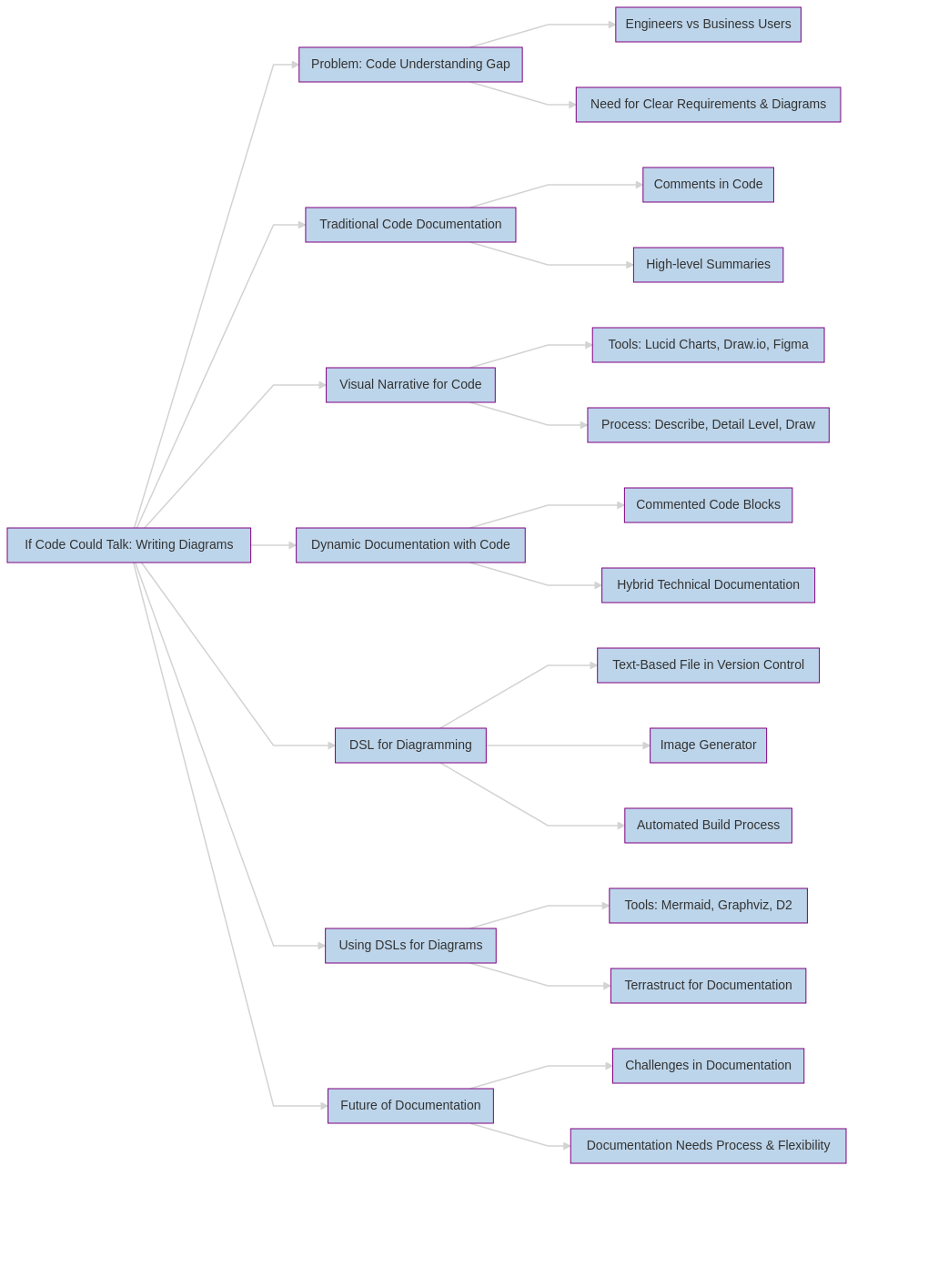
Is this summary perfect? Nope. At the moment it’s a topic or concept map helping you to know the major points of an article in the way you would write index cards when studying for an exam. But it did this for you automatically.
Where would we invest to make this better?
The goal is to build a superpower to summarize and learn about any topic, taking into account what you already know.
If the current iteration of this feature is v0, what would you do to improve it?
-
Identify Ideas: you’d want to not only summarize but also build a topic idea or idea map. What’s the idea? What does it advance?
-
Aggregate Knowledge: if this article identified unique knowledge, you’d want to group this into a topic map linking similar articles, especially one stored in your local LLM
-
Classify Knowledge: decide whether to add this new knowledge to the existing topic map. Is it a good argument and does it reinforce or contradict the existing map?
-
Answer Questions: it would be neat if you could then ask the topic map to answer questions and have it produce annotated answers based on the references stored in the topic map

If you remember the Card Catalogs that used to exist in libraries, that’s the basic functional idea. Identify a concept, find a related reference, and then assemble a topic map of related ideas.
What’s the takeaway? ChatGPT adds value by increasing the velocity to take in information. But more information without a filter is not particularly useful. Building a bot to help you identify, incorporate, and aggregate new information is an interesting feature.