I got 147 emails in my personal email yesterday. Amend that – it was the email I check most often, so I’m sure the total was higher. I don’t think that I’m that unusual, and I’d guess that many people get 10 or 20 times that amount daily for various reasons. This noise makes their inbox borderline unusable for inbound email.
The solution for most? Either ignore their inboxes, keep separate channels (secret email, text), or have a (virtual) assistant that guards the email gate for them. Solutions like Gated (open-sourced), Mailbox (acquired and shut down), Sanebox (filtering), and Superhuman (filtering).
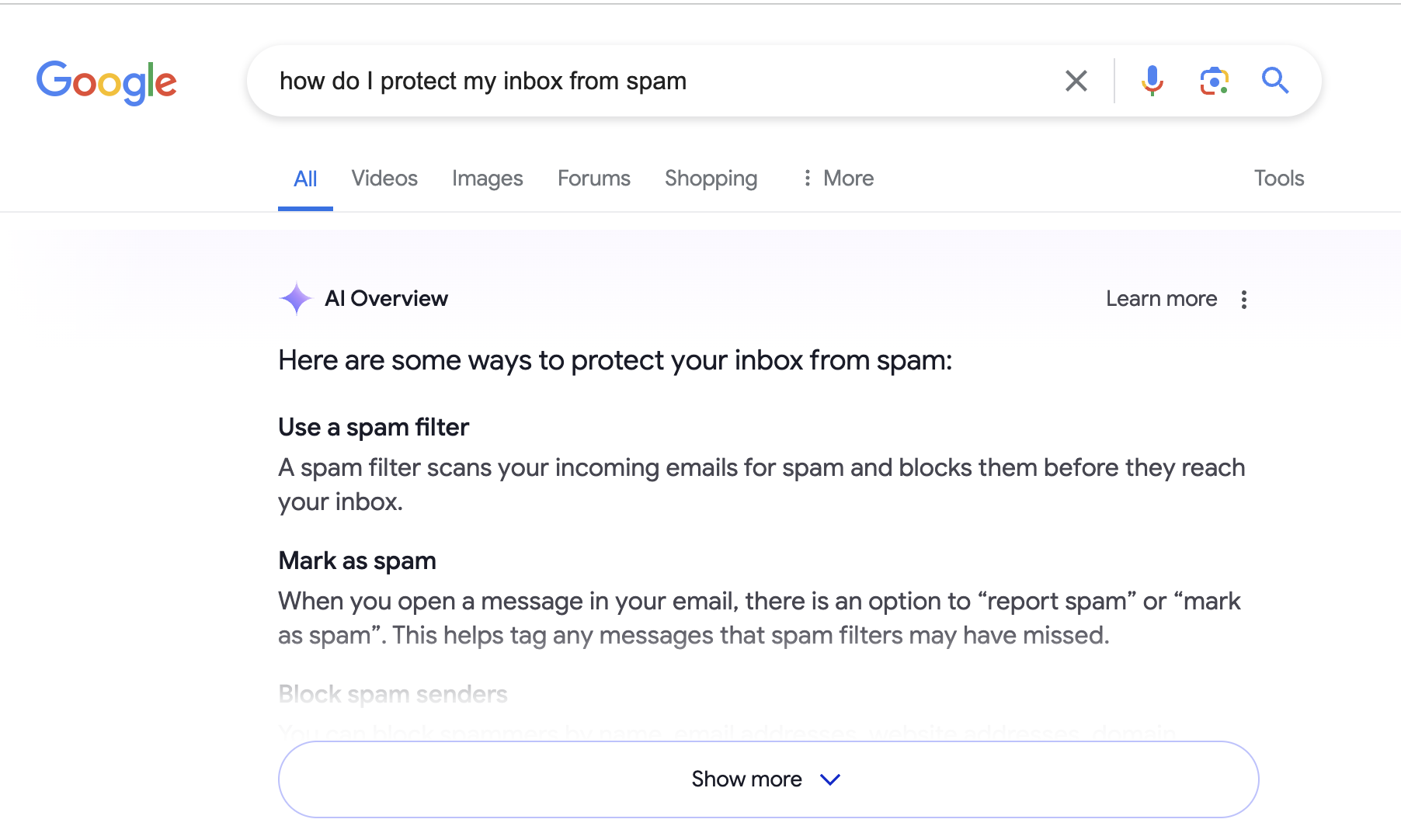
Search engines are jumping on this trend by mediating the content in results and presenting LLM-generated results instead of product content or traditionally optimized search results.
It’s only a matter of time before AI-generated rules make their way into the inbox.
That means cold email needs to change if you want to reach someone who isn’t expecting a message.
What exactly is AI-readable content?
The goal of cold email is to reach the inbox, provide value, and prompt a response. If you don’t send too many emails, keep the emails you send relevant, and avoid obvious spam triggers, you’ll have a better chance of reaching the inbox.
Deliverability is a dark art, but there are some obvious things that you can do to improve it, including having DKIM and SPF records for your domain, including unsubscribe links in your mail, and limiting the number of emails you send to bounced or suppressed emails.
But providing value … is more challenging, especially when your default is “I expect the reader will not read my email.”
Maybe we need to flip the script.
Here’s the hypothesis:
-
For the most part, people don’t read their email today
-
They rely on filters or AI-based prioritization to find the messages that matter
-
Mailboxes send “open” signals even when the email is not opened by the recipient
-
Mails opened in mobile clients often have trackers blocked
How do you break through this noise if you’re trying to send cold emails? You build content that gets noticed by AI or another autonomous agent after the fact.
If more people use clients that have AI features and you’re doing it right, that email will surface higher in the local search results when you ask it a question.
I know, you’re skeptical that people are going to have conversations with their email inbox. (Me too.) Think of email instead as a local resource for knowledge that people will soon grant to an AI feature in their email or a local, phone-based LLM.
This means that the knowledge in emails will form a retrieval augmented generation (RAG) resource for context mapping a person or a company when you ask an LLM a question. Emails with clear questions and answers around topics you care about will rank higher in this list.
Simply put, there is a new goal for inboxing: seeding relevant content (tokens) that are related to you or your company.
Emails AI is more likely to prioritize
AI likes context. One way you could rank your emails higher is to frame them so they answer a specific question related to your core message.
Instead of writing as a mid-sequence bump:
“Hey {first_name} –
Thoughts on improving your revenue situation? Let me know.”
You might focus only on answering a key question that your prospect has and do it an Q & A format that an LLM will identify when someone asks that question in the future.
There’s a strong overlap here with writing high-quality content and producing the kind of content that would provide context for an LLM as a high scoring answer for a question. Solid, concise answers with specific answers to the question someone is searching for look like great email.
But my short emails get the best response…
Except this is going to seem very different to most of us than the way emails work today, which look more like a text than anything else. When I’ve built campaigns that perform really well for cold outbound, the emails fit on a single screen.
Recipients decide to open or delete a cold email based on a subject line they review for only a few seconds, so pattern interrupts work. Unfortunately, they also feel like a parlor trick if the attention borrowed through the email is wasted.
But when I’ve built campaigns for branded trials and situations where people needed to learn things, the emails tend to be much longer, even though they have a single call to action.
The message? Send emails you would want to read. Now that AI is going to start being the gatekeeper, you might have to also start sending emails LLMs mark as highly likely to be related to the question your recipients ask their phone.
A postscript: dark SEO firms have resorted to creating fake people to get web eyeballs, a dark pattern called out by Matt Stanscliff here. Don’t make up stuff in your emails.
What’s the takeaway? Gatekeepers for email are not new. What’s new is that some of those gatekeepers are now powered by LLMs, so reaching the mailbox requires a combination of brief and informative messaging. What’s also new is that wordy, informative emails might show up a lot later as answers to questions in a personal LLM.