Everyone wants more customers. When they get new leads, comparing these new leads to existing customers is inevitable – both in comparison to successful customers and the closed lost opportunities that didn’t work out. The goal is to find more new leads that look like customers.
Prospective customer classification is important whether your sales motion is inbound, outbound, or “allbound” because it helps you understand where to focus your effort. There are always surprises but you get a sense when looking at a new lead for “this looks like a probable customer” because you pattern-match or search for “look-alikes” based on customers you know.
What’s a look-alike account?
Look-alike accounts share enough characteristics with your ideal customer profile (and hopefully, your existing customers) that you have a high degree of confidence they will ultimately become customers.
To find company look-alikes, you use a combination of factors, among them:
-
industry – companies in a similar line of work often have similar needs
-
employee size – similarly sized companies are at equivalent stages of scale
-
revenue – companies at similar revenue amounts often face similar challenges
Companies with similar scores on multiple factors are likely to be good prospects. If you’re in an industry where teams are highly online and look similar (for example: venture-funded SAAS tools aimed at helping sales teams become more effective at managing deals, these factors work well! Tools like Clay automate the process of matching new prospects to existing customers.
You could also use services like SimilarWeb and Comparables.ai to help you narrow the search down based on other common parameters like geographic location and website rank.
But this approach fails if the companies you’re tracking are more diverse. Common company enrichment providers do not track smaller companies or take a long time to add them to their indexes. It can take 18-24 months for accounts to show up.
Another way to find look-alikes
A decade ago, I led a team of researchers finding social profiles for companies worldwide. We had 10 people who validated the scraped information from company websites and matched them to Facebook, Instagram, YouTube, and other profiles.
After doing this hundreds or thousands of times, a pattern emerged. You could see very quickly from a scan of the company’s website which companies were skilled social practitioners. The website design, in other words, was a predictor of the company’s overall social reach. If you showed me 100 websites, I could make strongly educated guesses on which sites came from successful companies.
Fast forward to today – many companies want to find “look-alike” companies. If you search “competitors of [company name]” or “find similar companies to [company name]” you will see a one box result on Google using the searches other people make most often when searching for this company.
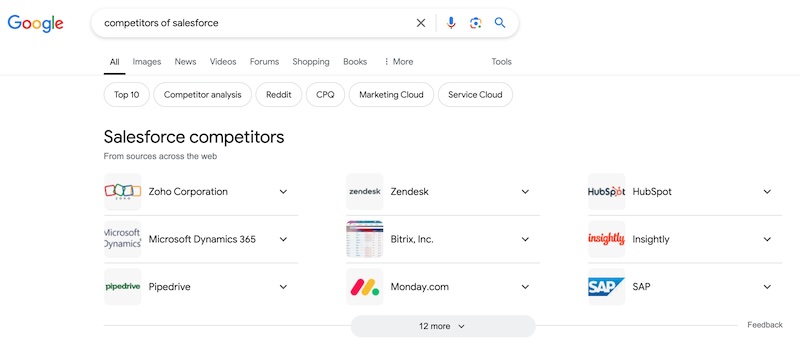
Templated searches work reasonably well for established companies (>3-5 years old) in established industries, and better for public companies than private ones. (Of course – there is much more information available for public companies than private ones – and new companies typically don’t have much of a footprint).
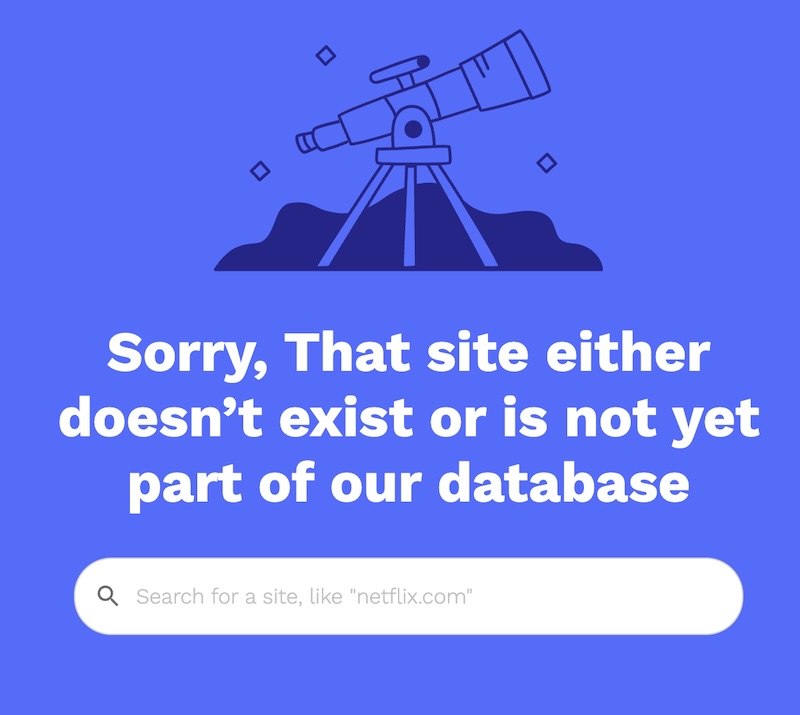
But what happens when you search for a new company or one with sparse competition? The results are not great, or the company might not be indexed yet.
A new way to find Lookalike Accounts
Let’s revisit the original insight from a decade ago used to match accounts.
Companies in a similar space with similar websites offer similar value propositions.
Even though website templates offer a much easier path to copying existing websites than they used to, the customer experience and look of a website is a powerful signal.
Here’s what I’d like to do to test this idea:
-
Assemble a list of URLs for prospective customers (if you want to, you can use either closed lost accounts that are sales-qualified or do a test using accounts you previously disqualified to see if you can uncover new leads)
-
For each URL, capture the home page for the business as an image
-
Next, reverse search google for similar sites based on that image (you can do this in a very basic way using Google lens)
-
Train an LLM to do this work or prototype with vector based similarity search
The goal: find enough similarity to create a rubric that can be completed by a person or an LLM to score accounts.
When I was testing this approach, the elements for similarity suggested by an LLM to reverse search matches using a screenshot were:
-
Visual Aesthetics
-
Navigation
-
Content
-
Content Layout
-
Typography
-
Branding and color scheme
LLMs process images and find similar results, though instead of a clear similarity match they create a prompt that results in thematically similar results based on the interpretation of the content.
The results were … pretty good! They weren’t perfect, particularly when I asked for additional information about each one of the sites, but they were solid matches for a similar business given the original screenshot.
What’s missing from this list that would make it even better?
-
backlinking to other popular sites, e.g. what you could learn from SimilarityWeb for the sites linked from an existing site?
-
use an agentic workflow to analyze the usability of a common flow, e.g. “sign up for a demo”, “book an appointment”, “order a pizza” without completing the action.
Seems like a good product avenue to pursue, and I’ll be looking for more progress in this area.
What’s the takeaway? When looking for accounts that seem like customers, sometimes the simplest comparison – looking at their website – lets you know if they’re worth pursuing. This is particularly useful for new accounts that might not appear in popular comparison services. Using a screenshot of the site is an interesting signal for research on similar accounts.