This week Tobi Lutke, the CEO of Shopify, made AI use at his company mandatory and wrote:
“Using AI effectively is now a fundamental expectation of everyone at Shopify. It’s a tool of all trades today, and will only grow in importance. Frankly, I don’t think it’s feasible to opt out of learning the skill of applying AI in your craft; you are welcome to try, but I want to be honest I cannot see this working out today, and definitely not tomorrow. Stagnation is almost certain, and stagnation is slow-motion failure. If you’re not climbing, you’re sliding.”
That’s a pretty broad statement, and makes you wonder how to respond. What does “Applying AI for your craft” mean?
How would you begin?
Building your first document with AI
What do you mean, building your first document with AI?
Most people are using AI in pretty rudimentary ways right now.
They are “using AI” as a consumer product:
- Asking ChatGPT questions about math problems and Salesforce formulas and Python code
- Having conversations with Claude to improve an idea
- Doing research for a trip or answering another question they would normally start with a web search
Lutke is arguing that we need to start thinking about AI as a collaborator rather than a black box that answers questions and tells pirate limericks (by the way, the jokes that AI “composes” are improving!)
AI (the collaborator) will support your writing, not replace it. You’re missing the point if you’re outsourcing your creativity to a robot. The reason to use AI as a business tool is enabling you to do more than you would otherwise, opening up the pathway to do much more engaged, personal work.
That sounds like a paradox. Let’s consider a historical parallel to get some perspective.
Do you remember your first digital photograph?
If you’re a person of a certain age (born before 1980 or so) you probably took your first pictures on a film camera and not a digital one. Photographers were skeptical of digital cameras when they were introduced. Digital imaging made it possible to take hundreds or thousands of pictures, and features like auto-exposure and advanced light metering brought the tools of professionals to the average “point and shoot” as they were derisively called.
A funny thing happened over time. The “general public” stopped using digital cameras as functionality and storage moved to smartphones. By 2019 the market for standalone digital cameras was ~10% of its peak.
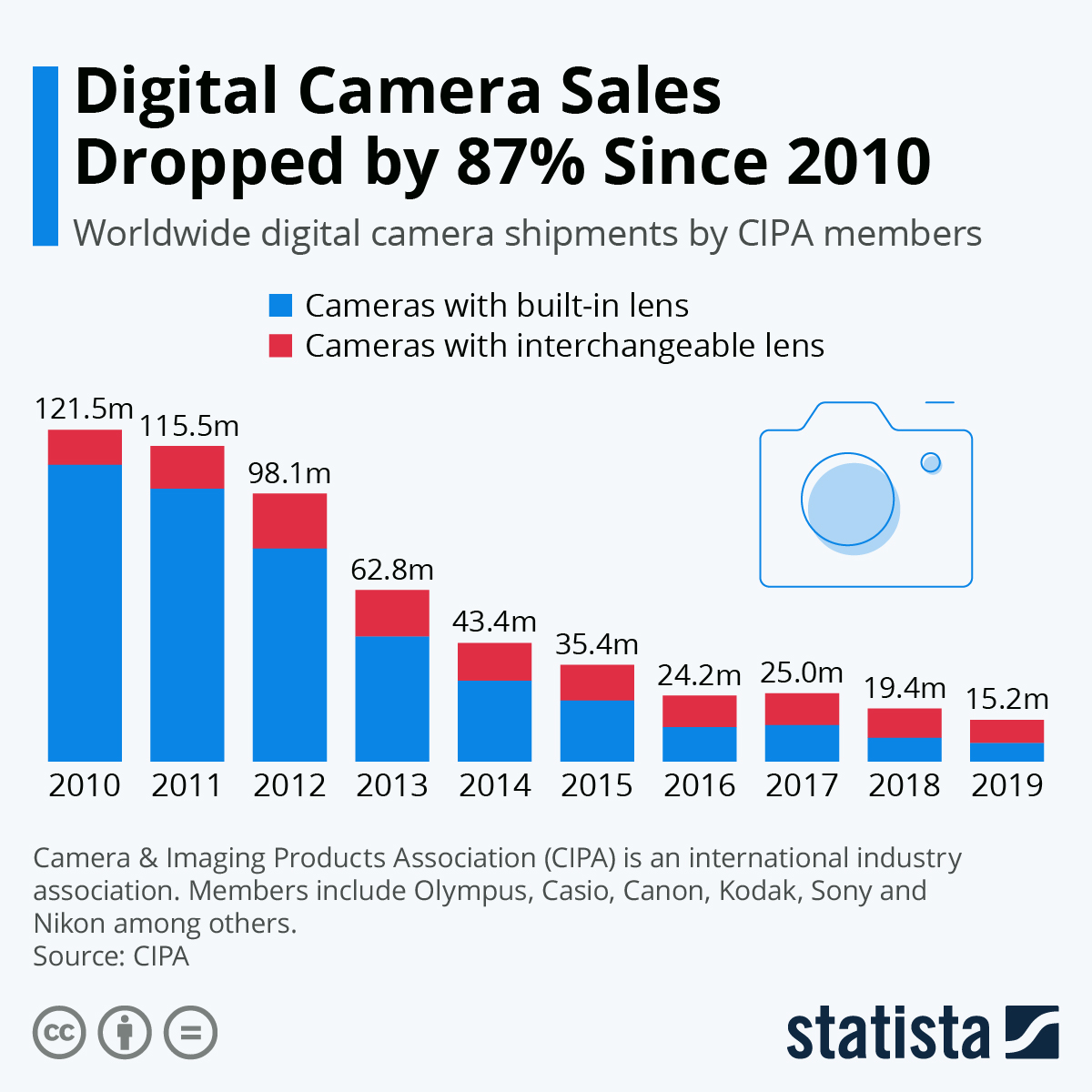
Did professional photographers disappear? There are probably fewer of them now but the main story is that the features they were using like auto exposure, smart focusing, and “bokeh” close focus have now become available to almost any consumer.
AI is doing the same thing for writing. Autofocus = autocomplete; Auto exposure = “smart suggestions”; and bokeh (“Portrait mode”) has become style filters and refinement.
These features made good photos easier and freed up the ability to focus on your creative side. The camera didn’t turn you into a robot. It helped you to create faster without worrying about the specific craft of how to do it.
Note: the extra features didn’t stop you from using the craft and becoming a great photographer.
Riffing with AI on a work document
Let’s try to fulfill the goal of “applying AI for your craft” with small steps because you won’t reach that goal immediately.
The next time you have a work assignment (a project proposal, blog post, or an internal document to share with another team), consider how AI can help improve “the blank screen”, use AI as your whiteboard.
Try this prompt:
Generate 5 unique angles I could explore for [your kind of document] about [topic, project]. Make them practical strategies, not academic.
Use this follow-up prompt when you’ve considered which one you like:
Expand idea #2 into a short paragraph or outline. What’s the hook? What questions would you answer? [If others are involved, add …] What questions would the [stakeholder team] typically ask?
Suddenly, you’ve moved from copy and pasting your old document to coming up with a new approach and validating as you go. Alternately, start with the previous document (provided it doesn’t have PII or proprietary information) to deliver context and frame the writing.
From Outline to Finished Document
Now that you’ve got an article, AI can also help with the shape of the information.
Try this prompt:
Based on what we’ve discussed so far, create an outline for [your type of document]. Include an executive summary of no more than 50 words, a few main sections, and a goal statement. Please also suggest 1-3 actionable metrics as outcomes.
This process gives you a structure to edit. If you’re like me, editing and pruning content can be as fast or faster than writing from a cold start. While you’re working, it’s easy to get feedback.
Now use AI as a copy editor to find out whether what you’re doing is working:
Does the [type of document] do a good job of fulfilling the stated objectives and goals? What areas are weak and need to be improved?
It’s also easy to get other editing suggestions such as improving the output in tone or content length. AI is here to give you the bones and structure of a new document, but not necessarily to write it for you.
Can you help me make this paragraph shorter while not changing the tone or meaning?
So that statement above now sounds like a paradox: how can you let AI write for you without changing the meaning?
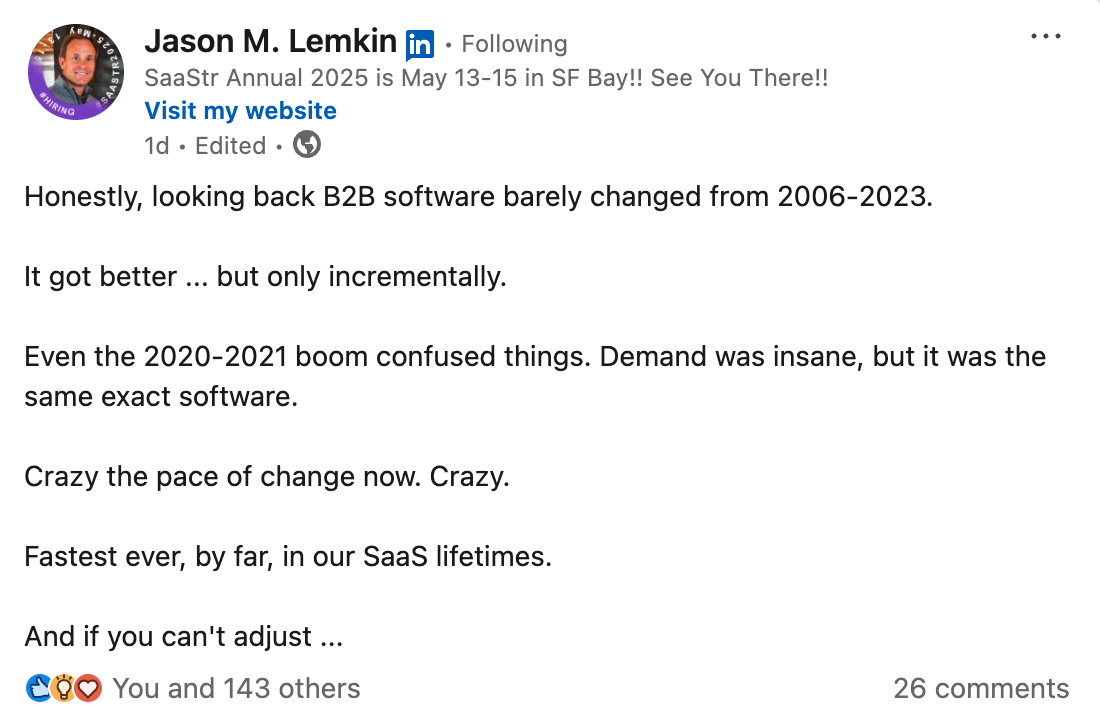
I think that’s the essence of what Tobi Lutke is suggesting when he asked his team to use AI every day. The field is changing daily, and VCs and industry pundits are following the pace of innovation.
Honing your craft with AI
So now you’ve learned how to use AI at work, and you’ve figured out the right way (for you) to incorporate these tools into your flow.
What does “honing your craft” really mean?
The core message isn’t “you must become an AI expert”, it’s:
You must learn to delegate better—to machines.
Just like calculators didn’t kill math skills (they enhanced them), AI won’t replace your strategic brain—but it will challenge you to move faster, think broader, and produce higher-quality work in less time.
What are three ways you can get started?
- Use AI for brainstorming this week
- Structure your next work doc with AI help
- Share one AI-assisted win with your team
What are you waiting for? The future is coming, and getting better a little bit every day is a solid way to prepare.
What’s the takeaway? Tobi Lutke’s call to action to use AI as a collaborator frames AI as a creative partner. He doesn’t know the best way to use AI in your job, but you can … if you experiment. The idea is that it’s no longer optional to sit on the sidelines and not use AI. To the extent that it’s allowed and compliant in your organization, you need to go play.